Extracting Tacit Knowledge From Retiring Subject Matter Experts
Experts can't articulate their own knowledge, but AI can extract it from their behavior.
- Written by
- Desmond AchterbergStaff Writer
- Published
- October 12, 2026
- Reading time
- 9 min read
- Sources cited
- 2 sources ↓
What this covers
- Why the current retirement wave makes this problem acute rather than chronic
- What behavioral observation and digital exhaust can surface that interviews cannot
- How LLMs extract tacit knowledge from expert behavior more reliably than experts can articulate it themselves
- The hard limit: somatic and sensory knowledge that behavioral capture cannot fully reach
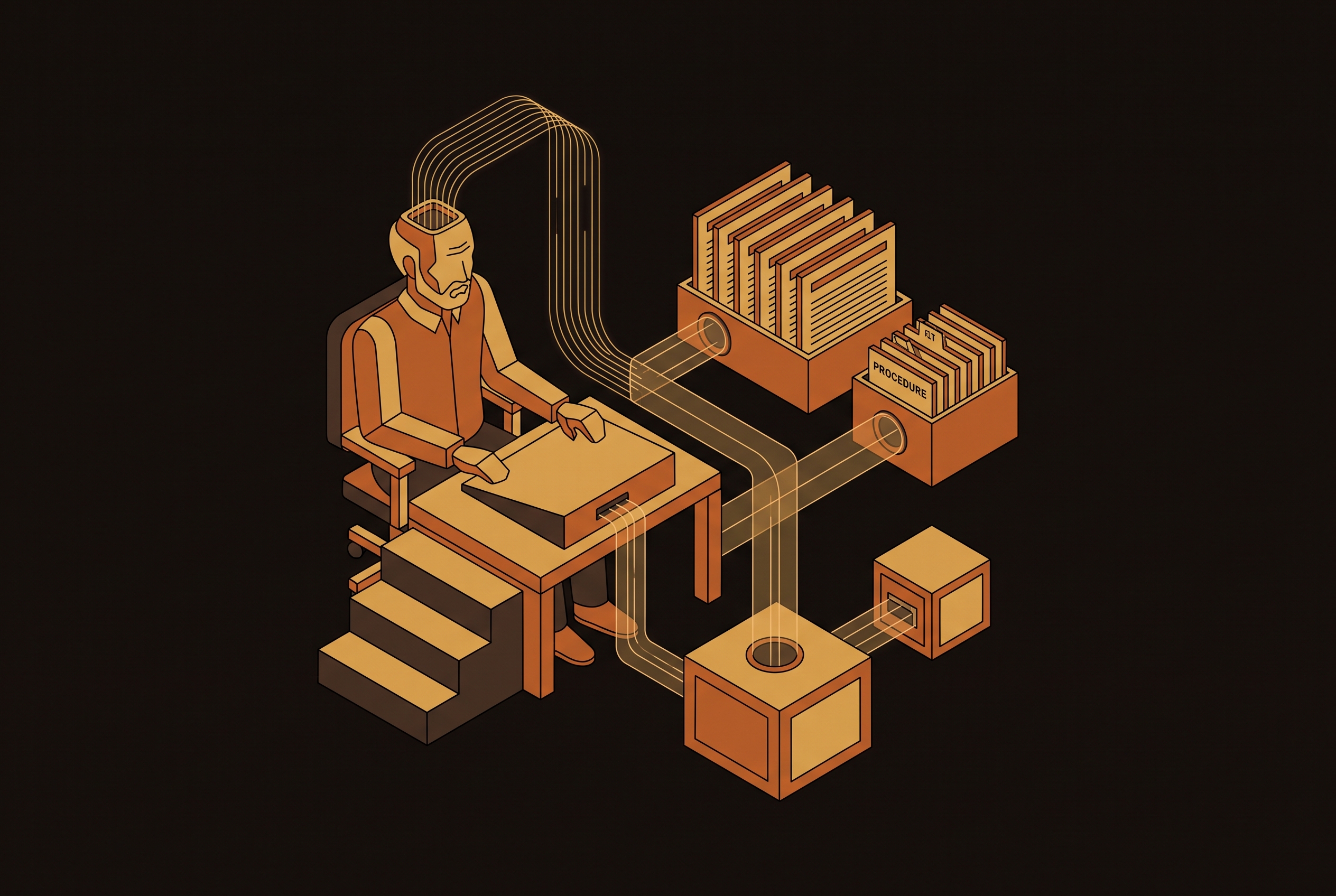
Tacit knowledge is the know-how a person can perform but cannot fully explain, and the gap between what an expert does and what an expert can say is not a lapse in effort. Research from the Carlson School of Management names this Polanyi's Paradox, the observation that "we can know more than we can tell," and treats it as the foundational constraint on any knowledge transfer method an enterprise might choose. You can already find explicit knowledge in a document, a wiki, or a metric definition somewhere in the organization. Tacit knowledge lives in individual experience and context, not in any system a company owns, so it falls outside that layer of explicit knowledge. None of that maps onto a procedure document, because none of it was ever a procedure to begin with.
The methods enterprises already use to elicit this knowledge, exit interviews, semi-structured interviews, protocol analysis, concept mapping, cognitive task analysis, were built for explicit knowledge and strain badly against tacit knowledge's actual shape. The stakes are highest exactly where enterprises are now deploying AI agents, because an agent that hits an undocumented exception infers an answer, often wrong, with total confidence, where a new hire would stop and ask the person down the hall. The failure is structural, so you need a structural response, and no interview template can fix it.
Why the current retirement wave makes this problem acute rather than chronic
The retirement wave now underway differs from earlier waves of institutional turnover in a specific way: the people leaving are the largest cohort in absolute numbers, the most concentrated in operationally critical roles, and the least replaceable from the labor market currently available. In organizations built on a Hidden Champion or Mittelstand model, expertise tends to concentrate in a small number of people by design. When that person leaves, the organization loses not just one employee's output but the accumulated judgment that several other roles were quietly built on top of.
"We will hire someone" does not solve this, because the labor market for these roles is thin and the knowledge that would let a new hire ramp quickly was never written down anywhere a new hire could find it. Squirro identifies three compounding costs that follow when this knowledge leaves the building undocumented: a "re-inventing the wheel" tax as successors recreate work from scratch, operational fragility as tribal knowledge sustaining critical systems or client relationships simply disappears, and a competitive stagnation trap as peers who captured their own institutional knowledge earlier use it to accelerate their AI onboarding while the slower organization is still rebuilding basic procedures.
The timing of capture is not a scheduling preference. If capture begins at the retirement announcement, it is already working from memory, the expert's and the organization's both, and memory is where tacit knowledge degrades fastest.
What behavioral observation and digital exhaust can surface that interviews cannot
Because experts cannot fully verbalize their own reasoning, the more reliable capture method observes what an expert does rather than asking the expert to narrate it afterward. A retrospective account, however well-intentioned, gets filtered through editing and self-consciousness that behavioral observation simply bypasses.
Digital exhaust, the emails, Jira tickets, support threads, call recordings, and work orders that organizations already generate, contains behavioral traces of tacit knowledge that were never intended as documentation but function as it anyway. Interloom, headquartered in Munich and having raised $16.5 million in March 2026 led by DN Capital with participation from Bek Ventures and Air Street Capital, operationalizes the same idea as a "context graph," ingesting millions of operational records to map the paths that operational experts actually take to solve problems. Jakobi's underlying point carries real weight: roughly seventy percent of operational decisions have never been formally documented, which makes the behavioral record sitting inside operational systems the closest available proxy to the knowledge itself.
If reasoning is captured at the moment it happens rather than reconstructed afterward, an AI agent can actually use it. One limit deserves a flag here and a fuller answer later: some tacit knowledge is sensory and embodied, and no amount of behavioral observation reaches it fully. That objection gets addressed directly further on.
How LLMs extract tacit knowledge from expert behavior more reliably than experts can articulate it themselves
Empirical research from the Carlson School of Management found that LLM-externalized tacit knowledge improves decision quality and lets novices approach expert-level performance, often outperforming the knowledge experts articulate when asked to explain themselves directly. That finding runs against the intuitive assumption that the expert is always the best source of their own expertise, and it is the strongest evidence behind the case for AI-assisted elicitation. The mechanism works like this: LLMs process large volumes of context-dependent behavioral data to identify latent patterns that experts rely on but cannot name, then express those patterns as concrete decision steps in natural language a novice can follow. The model infers the reasoning from the record of what the expert actually did across many cases, sidestepping the articulation bottleneck rather than trying to push through it, instead of asking the expert to explain their reasoning.
The study tested this directly in a math tutoring context: it compared how expert teachers responded to student mistakes against how an LLM, given access to that same expert behavior, externalized the underlying decision process. Mechanism analyses and robustness checks in the study confirmed that LLMs meaningfully learn and extract knowledge from expert conversations, and the findings held across different models and different retrieval methods, which suggests the effect is not an artifact of one particular model architecture.
None of this replaces the human expert. The AI layer and human mentorship work as complements: AI handles the explicit and articulable at scale, which frees the senior expert's limited time for the deep transfer that only shared work creates. Squirro's pipeline operationalizes exactly this combination: an LLM here acts as a pattern extractor working from what someone actually did, not a documentation tool recording what someone said.
The hard limit: somatic and sensory knowledge that behavioral capture cannot fully reach
Some expert knowledge is somatic rather than cognitive, living in the body's trained responses rather than in any sequence of decisions a system could log. Asking that person to describe the sound in words, or recording their diagnostic sessions on video, captures the decision that follows the perception. It does not capture the perception itself.
The honest response to this limit is not to abandon structured capture but to be precise about what it preserves and what it does not. For somatic and sensory knowledge specifically, the right response is extended overlap periods, apprenticeship, and structured observation while the expert is still physically present and still working. The capture methods described earlier reach the cognitive and behavioral layer of expertise well. Human mentorship exists to reach what those methods cannot, so the next question is how you turn the knowledge you can capture into something that actually changes how work gets done.
Encoding captured knowledge into agentic workflows so it changes operational outcomes
Captured knowledge sits inert until you structure it into the workflow layer where decisions actually happen, and that structuring is what moves you from knowledge management to operational AI. Atlan's framework places captured tacit knowledge inside an AI context stack, a structured layer between raw metadata and the context an AI agent can actually query, so it grounds the agent's answers in certified context instead of letting the agent infer from schema alone. Squirro's architecture describes the endpoint this is building toward: a knowledge graph that employees query through a conversational interface, while AI agents use the same graph as foundational memory to execute complex, context-aware workflows. The same corpus serves human successors and automated agents at once, turning the capture investment from a one-off documentation exercise into a source of ongoing payoff on two fronts. Yuan (2026) calls for "tacit signal infrastructure," AI systems designed from the start to model expert sensing longitudinally over time rather than processing explicit knowledge through isolated, point-in-time queries.
What this looks like in practice varies by domain, but the pattern repeats. The resulting log of holds and releases then becomes its own source of tacit knowledge for the next cycle of capture.
How you frame this to the expert whose knowledge you are capturing decides whether the program works. Consent and attribution are operational requirements for a capture program, not soft considerations layered on afterward for comfort.
The AI Operations Audit and Tacit Knowledge Gaps
Most enterprise AI programs stall for a reason that has little to do with the model's capability: the surrounding workflow documentation, data access, and operational context were never structured well enough to support a system making real decisions on its own. Atlan's framing of this failure mode is precise. An AI agent answers confidently with whatever the schema tells it, right or wrong, and the failure traces back to missing context that a veteran employee would have supplied automatically. An AI Readiness Assessment evaluates an organization's technical, operational, and cultural capacity to deploy AI, surfacing gaps in data, security, and workforce readiness before an enterprise commits significant capital to a deployment that those gaps will undermine.
Organizations routinely underweight one dimension of this assessment: operating model and process documentation, which is precisely where tacit knowledge lives and precisely where an audit that skips it will wave through a deployment destined to fail on its first undocumented exception. A structured audit maps which workflows depend on veteran judgment for consequential decisions, which of those decisions have behavioral traces you can recover from digital exhaust, and which need extended overlap or apprenticeship because no behavioral trace will ever substitute for the real thing. That mapping turns tacit knowledge capture into a scoped, prioritized program instead of a vague organizational aspiration, so you get a sequenced plan built months in advance instead of panic capture at the retirement announcement. For regulated industries, healthcare, legal, and financial services among them, the audit also has to establish what documented audit trail an encoded agent will need to produce for compliance purposes. In high-risk use cases, current regulatory frameworks require human oversight before consequential actions; it is built into the deployment, not a design preference left to the organization's discretion.
A Realistic Capture Program: A Sequenced 24-Month Plan
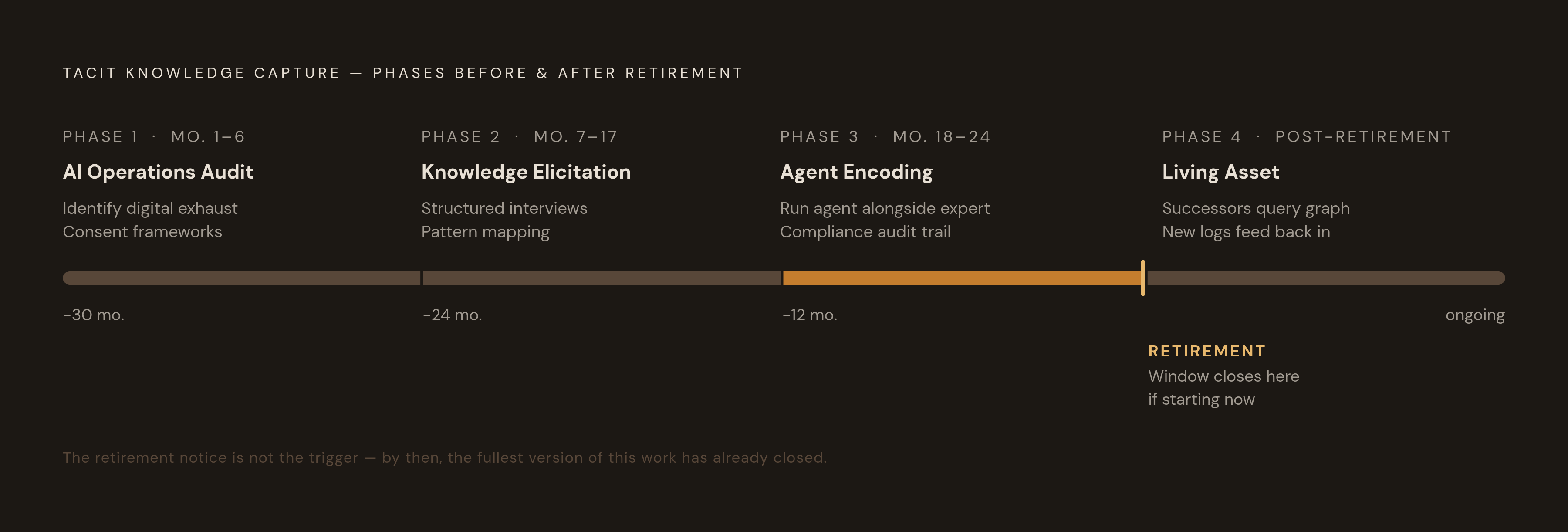
A capture program that actually works is not a one-time project. It runs in phases that begin well before an expert's retirement and continue through the first year of a successor's independent operation. Phase 1 spans months one through six, beginning 24 to 30 months before retirement: an AI Operations Audit identifies which processes carry undocumented expert judgment, which have recoverable digital exhaust, and which require structured observation or extended overlap, while consent and attribution frameworks get established with the expert directly. Phase 3 covers months eighteen through twenty-four, running through the retirement date itself: extracted knowledge gets encoded into agent workflows at the specific decision points the audit identified, the agent runs alongside the expert so discrepancies surface whatever gaps remain, and the audit trail required for regulatory compliance gets built out. Phase 4 begins after retirement, month twenty-four onward: successors query the knowledge graph for answers, new decision logs feed back into the graph as ongoing input, and the encoded workflow gets treated as a living asset that continues to grow.
This sequence exists to discipline organizations against the most common failure in this entire effort: starting too late. The retirement notice is not the trigger to start capture. By the time it arrives, the window for the fullest version of this work has already closed. The framing offered to internal stakeholders should follow the same spirit that governs the expert's own participation: the program exists to preserve the expert's legacy and let the next person learn from them, not to manage their replacement or justify headcount reduction.
The return on this work extends past knowledge preservation alone. The behavioral record built during capture becomes the training and validation data for the agent that follows, so you make the investment in capture and the investment in deployment once, together. Squirro's endpoint illustrates where this lands: successors query a predecessor's accumulated judgment through a conversational interface and get grounded, cited answers back, while AI agents draw on that same knowledge graph as foundational memory for complex, context-aware workflows. The capture effort serves the human successor and the machine successor at the same time. Against that return, the cost of the program reads as a line item. The cost of skipping it compounds quietly, in operational fragility, in AI deployments that fail on their first undocumented exception, and in a widening gap against competitors who started capturing their own experts' knowledge while there was still time to do it properly.
Methodology & sources
- Large Language Models Explain Experts Better Than Experts Themselves
Provided the empirical findings on Polanyi's Paradox and the Carlson School study showing LLMs outperform experts at externalizing tacit knowledge.
- Tacit Signal Infrastructure: Towards AI Systems that Model Expert Sensing Over Time
Provided the concept of 'tacit signal infrastructure' for AI systems designed to model expert sensing longitudinally over time.