Integrating AI Agents With Dealership Management Systems
DMS vendor permissions, not AI capability, determine what agents can actually accomplish.

Integrating AI agents with dealership management systems depends primarily on write paths and permissions. An agent can execute only the parts of a workflow that the DMS permits it to touch. Dealers therefore need to map access to the system of record before evaluating autonomy, production readiness, or return on investment.
Why the DMS — not the AI model — is the real constraint on what an agent can do
A promising pilot can stall after two weeks because nothing the agent produces can land in the DMS. The model drafts a useful repair-order story, but an employee must still transfer it into the operational record. The demonstration worked, but the workflow did not. The obstacle is not necessarily the quality of the generated text, but the absence of an authorized route into the system that makes the transaction real.
The DMS holds the customer record, vehicle, repair order, parts inventory and pricing, accounting ledger, and warranty claim. In fixed operations, work must become an RO in that system. CRM, scheduling, texting, and inspection tools sit above it and must eventually reconcile to it. The decisive questions are therefore whether the output can enter the DMS, who is contractually permitted to put it there, and what that permission costs.
How the franchise DMS market is structured and why that structure governs integration options
The Federal Trade Commission described CDK and Reynolds as the two largest providers of DMS software to new-vehicle dealers in the United States in its 2018 challenge to CDK’s proposed acquisition of Auto/Mate. That establishes concentration without assigning unsupported market shares. Integration operates within that concentrated vendor landscape. Each major provider runs its own access program, so a third-party agent needs more than the dealer’s approval to act.
The dealer is generally not a party to the agreement between the DMS vendor and the integration vendor, even though the records concern the dealer’s customers and vehicles. That separation creates a practical contractual asymmetry. The dealership can authorize a business task without controlling the terms under which another vendor reaches the records needed to perform it. What an integration can do therefore depends on both what the technology allows and what access the DMS vendor permits and charges for.
The five-rung integration ladder and where each rung leaves an agent's real capabilities
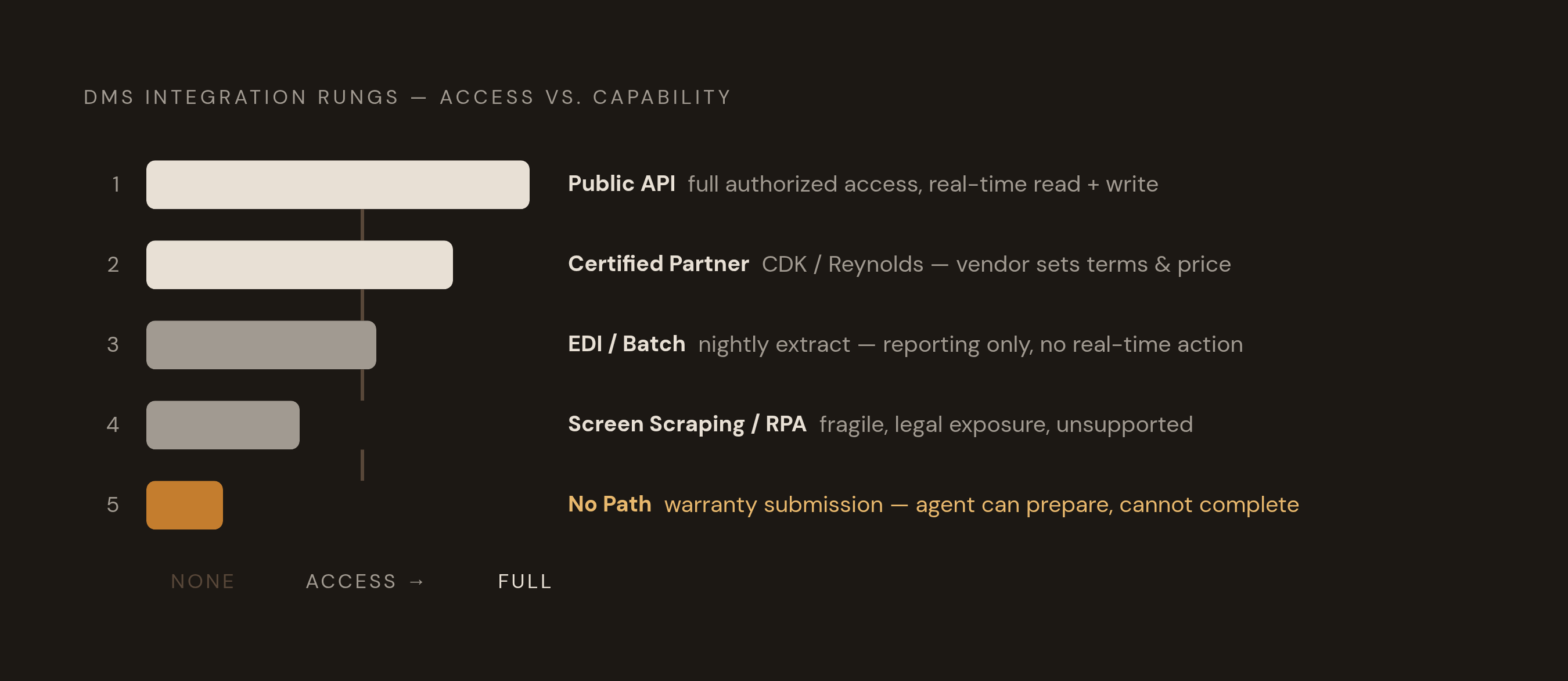
The first rung is a documented public API that the DMS vendor publishes and maintains for authorized parties. It is the most cooperative arrangement. The second rung, a certified partner programme, is the practical standard for franchise DMS integration. CDK Global’s Third Party Access program and the Reynolds Certified Interface sit here, and each vendor sets the terms, tiers, and separate prices for access.
The third rung is an EDI or batch file extract, which moves data on a nightly or scheduled basis. This can support reporting and analytics agents, but not actions that depend on current state. Last night’s extract cannot show an RO that closed this afternoon. The fourth rung, screen scraping and RPA, instead consumes the presentation layer of a system holding consumer financial data. Because the vendor can change that layer without notice, this route creates fragility and legal exposure rather than the supported access associated with a certified interface.
The fifth rung is no path at all. For warranty claim submission, the access map shows no verified route for a third-party agent to submit a claim. An agent can prepare the claim without being able to submit it. These rungs are therefore not interchangeable versions of “DMS integration,” but different arrangements for vendor cooperation, contractual exposure, and operational capability.
Cox’s Xtime demonstrates how much depth can vary even within sanctioned integration. Xtime markets bi-directional repair-order management and parts writeback specifically into Dealertrack DMS, which belongs to the same corporate family. The supplied documentation leaves comparable write depth into CDK or Reynolds unverified, limiting the distinction to documented access. Access within one corporate family gives no assurance that every outside integration vendor can get the same access.
What each DMS object actually allows — reading, drafting, and writing back are three different things
Reading a record, drafting content for review, and modifying the DMS are distinct operations with different permissions, costs, and risks. A smooth conversational interface can make those boundaries hard to see in a demonstration. Each object still has its own permissions. Customer and vehicle records can usually be read through a sanctioned extract, but writing to them falls under a separate tier with its own price.
Repair orders follow a similar division, but span several actions, including opening, dispatching, adding stories or labor lines, and closing. Read access is common. Writeback requires a package the vendor sells and the dealer authorizes. Agents can read parts availability and pricing, but orders generally have to go through DMS and OEM rails.
Accounting access is narrower still in the published access map. Ledger reading is described as the most expensive access tier, while write access is not described. Service appointments and shop capacity have their deepest published write path in the Xtime integration discussed above, rather than a universal interface available across DMS products.
These distinctions change what a dealer is buying. An agent that reads data and builds a work queue has no external effect and offers a reversible starting point. A draft that an advisor edits saves keystrokes without transferring the decision. An agent needs the vendor’s express permission to create or change a record directly. The practical evaluation must therefore identify each object, its integration rung, its permitted operations, and any additional fee, rather than accepting a workflow name as proof of access.
What agents can realistically own end-to-end today versus where humans must stay in the loop
Agents have the most room to work on their own when administrative work follows set steps, comes in large volumes, has an available write path, and has few compliance demands. Lead capture and the first response fit that pattern because after-hours internet leads can go cold before a person calls. An agent can respond within seconds instead. Cerence AI’s dealer assist agent, which debuted at CES 2026, automates lead capture, test drive booking, and service scheduling through CRM and DMS integration, while providing real-time updates and routing high-value interactions to dealership staff.
Numa’s Opportunity Agent surfaces declined and unsold work already in the DMS and books it through a read-then-act workflow, with open-RO modification outside its scope. Numa also describes its platform as answering calls and texts, booking appointments, and flagging unhappy customers while they are still in the shop. These are bounded actions with defined operational destinations. Their scope is more concrete than a broad promise to automate service operations.
People still need to oversee work when an agent’s access ends or the effects of its actions call for approval. An agent can prepare a warranty claim, but a person submits and attests. It can also draft the three-C story, covering complaint, cause, and correction, while RO closure and the resulting accounting entry require human authorization where writeback is unavailable or inappropriate. FCC ruling 24-17 treats AI voice calls as artificial or prerecorded voice calls, so marketing calls under the TCPA need written consent and can go ahead only with a confirmed consent record.
How to scope an integration before a pilot starts — the questions a dealer must answer about their own DMS
Before a vendor conversation, a dealer or operations leader should turn the access framework into a practical scope check. The dealer should first identify which DMS is in use and which certified-integration program governs third-party access. The answer determines the applicable terms and pricing. The dealer should next identify which objects the proposed agent will touch, at which rung, and whether each operation is reading, drafting, or writing back.
Is writeback already included, or does it require an addendum and fee negotiated by the dealer, the AI vendor, or both? The scope must also identify workflows that remain human-operated because access is closed or compliance intensity is high. Warranty submission and marketing outreach require explicit boundaries. Finally, what is the rollback procedure for incorrect bookings or unauthorized outreach, and which party owns the response?
Context needs examination as well as access. Verifacto illustrates the connected-platform approach of bringing CRM, DMS, and LMS data into a single context layer. Without that link, lead details, vehicle availability, financing progress, and service records stay split across systems. When context is missing, employees may have to check information or do tasks again. Connecting those records addresses that gap, but does not itself establish permission to modify them.
The recommended starting scope is one well-defined task with a clear write path. Stability should be demonstrated before the agent’s remit expands. This ties the pilot to a clear responsibility for a task, giving it a focus beyond a set of promising demonstrations. Who owns that responsibility once the agent is live?
Governance and ownership structures that make the difference between a stable production agent and a stalled pilot
A correctly integrated agent can still stall without an operational owner. Someone must spot drift, handle incidents, and decide when the agent is ready to take on more work. In a dealership, those duties are concrete. An appointment error can create a shop-capacity conflict, requiring someone to detect it and correct the DMS record. An overloaded advisor can treat an RO draft as final, defeating a human-review design even though the integration behaves as intended.
Consent controls create another ownership requirement for outbound voice workflows. A policy does not replace a consent register. The NIST AI Risk Management Framework organizes risk work around GOVERN, MAP, MEASURE, and MANAGE, providing a structure for assigning these responsibilities. Applied to a dealership, that means examining whether the DMS supplies clean, connected, governed data, who owns each workflow, and how rollback works.
Product controls can make that oversight operational. GetVocal’s Context Graph makes AI decisions visible and auditable, while its Control Center lets BDC managers intervene in live conversations. Human oversight is built into the operating environment.
An AI Operations Audit takes up those questions before a pilot begins. It evaluates strategy, data, infrastructure, governance, and processes to assess readiness to scale AI. For a dealership, the assessment includes DMS data quality, a named workflow owner, and documented incident response. These are deployment conditions. They also establish the controlled operating scope needed to distinguish an agent’s contribution from activity that cannot be attributed.
How to measure what a DMS-integrated agent actually delivers — and prove it to a CFO
A dealer may know how often an agent responded without knowing what changed in the DMS as a result. When the write path is vague, the downstream outcome is difficult to attribute. Measurement therefore begins with defining the workflow and its operational endpoint.
Before launch, the dealer should document cycle time, error rate, fully loaded cost per unit, and process throughput for every workflow the agent will touch. The baseline needs a sufficient pre-deployment measurement period and a method that can be repeated exactly afterward. It must also be shared with the CFO before deployment begins. Agreement on the baseline precedes any credible ROI claim. Otherwise, reported gains may be measured against a starting point that was never measured in a consistent way.
Healthcare provides a useful analogy for where those returns are concentrated. Administrative workflows such as revenue cycle management, appointment scheduling, and collections follow-up give automation a different role than clinical work that relies heavily on judgment. The dealership equivalent is structured administrative volume. A clear write path lets the agent complete a bounded task whose cycle time, errors, cost, and throughput can be compared.
Production readiness and measurable ROI therefore belong in the same deployment decision. A named workflow, authorized access, accountable ownership, and a documented baseline give the CFO something to evaluate beyond a demonstration. Dealers that map the write path first can build toward measurable operating results. Dealers that start with the demo risk discovering the missing permission only after another pilot has stalled.