Knowledge Decay Rate in High-Turnover Operational Roles
Institutions lose operational judgment faster than they can rebuild it when roles turn over.
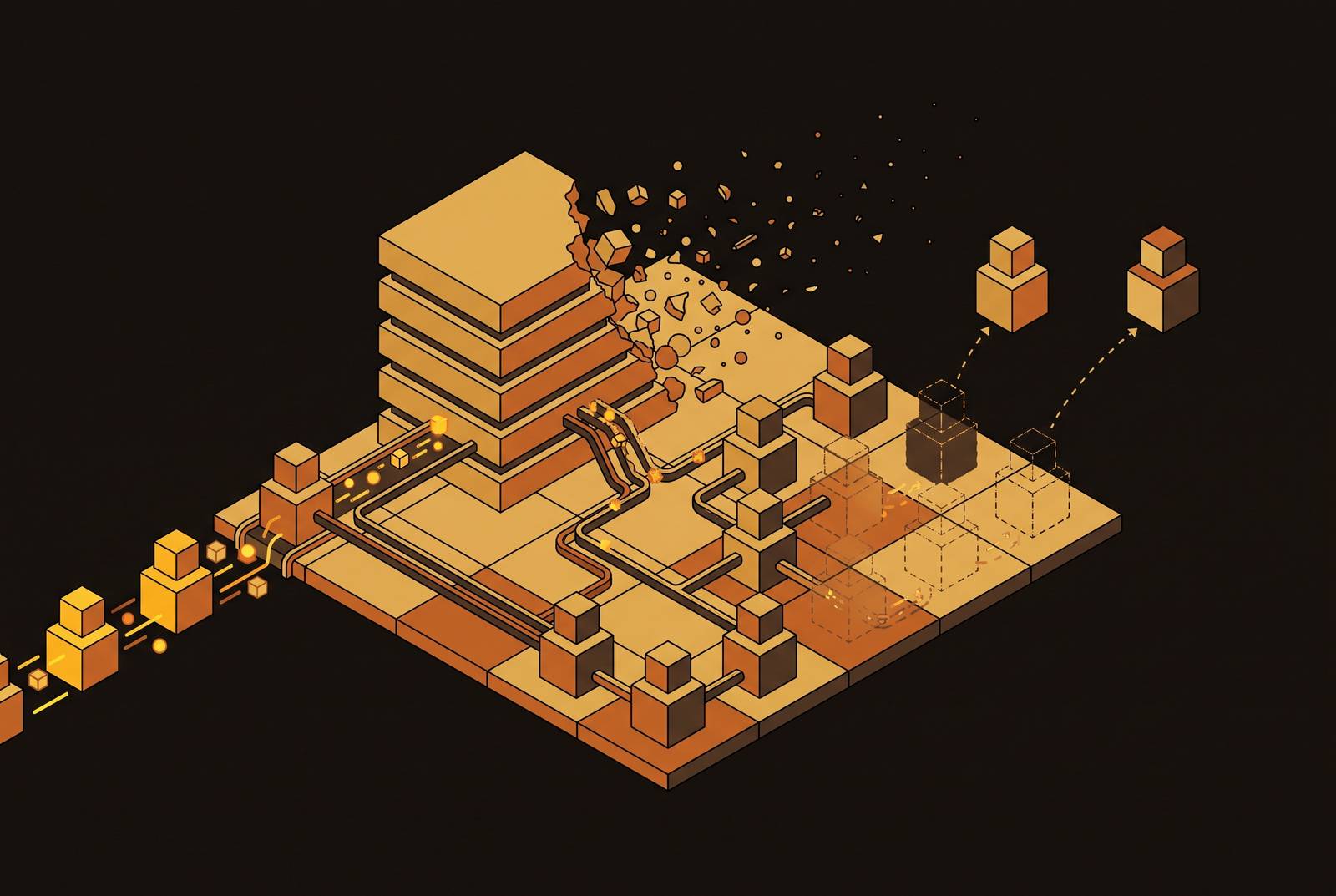
Knowledge decay in high-turnover operational roles is a compounding structural drain that persists after a vacancy is filled. Each departure can leave the next employee with less context to inherit and less time to rebuild it. Operations leaders therefore need to measure the rate of decay and design systems to slow it, especially before deploying AI agents that depend on the same institutional knowledge.
Why operations roles lose knowledge faster than other functions right now
Operations has higher attrition than engineering and is currently the highest-attrition function in enterprise organizations. The contrast reflects a structural change in the function. Routine operational tasks are being automated or outsourced, while strategic operations work is absorbed into product, engineering, and other functions. Operations is being dismantled from both ends. As responsibilities move, the people who understand how those responsibilities connect become harder to retain as a stable knowledge base.
Those connections are not incidental to operational work. Operations employees hold the process context that connects automated systems to business reality, including the exceptions and dependencies that formal workflows do not explain. When these roles turn over, the systems may remain available while the understanding required to use them correctly disappears. Automation changes where the continuing dependency on human context becomes visible.
The Bureau of Labor Statistics reported median employee tenure of 3.9 years in January 2024, the lowest point since January 2002, followed by 4.1 years in January 2026. These figures cover all wage and salary workers, with knowledge workers and operations employees included in that aggregate. They establish the broader workforce backdrop of roughly four-year tenure. Operations is cycling faster than that, leaving less time for experienced employees to transfer context before their replacements must apply it independently.
What kind of knowledge actually disappears when an operations employee leaves
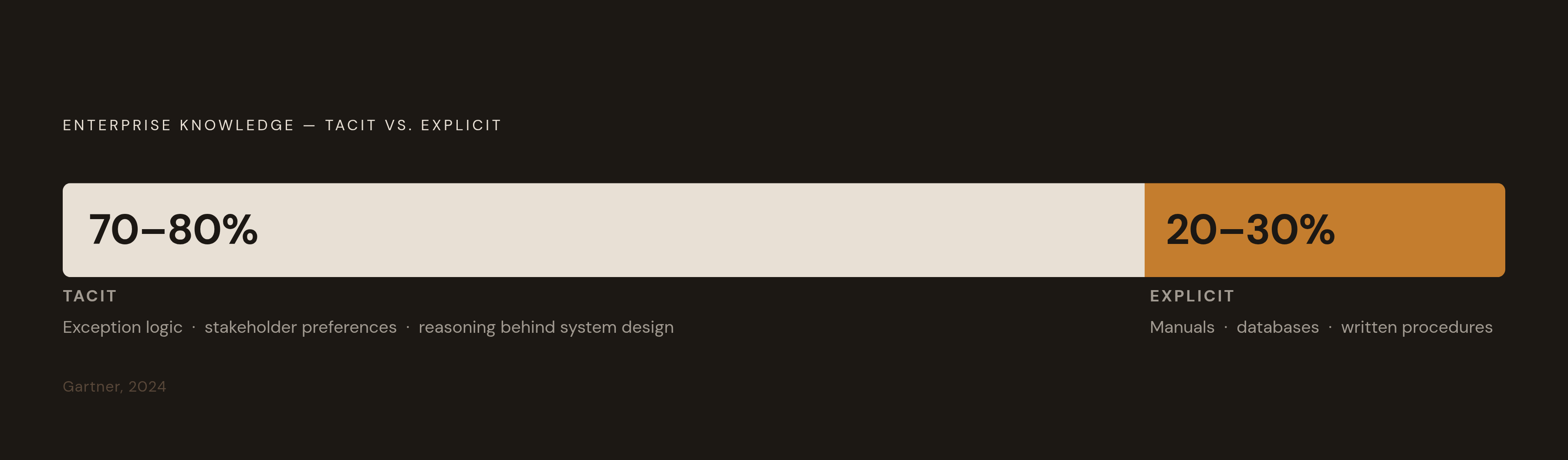
The knowledge most exposed to departure is tacit. It consists of context and judgment that employees use without having fully documented it. In operations, that includes knowing which processes have exceptions, which stakeholders have unwritten preferences, and why systems were built in a particular way. A replacement may inherit the procedure without inheriting the reasoning that makes its exceptions intelligible.
Gartner's 2024 estimate puts the tacit share of enterprise knowledge at seventy to eighty percent. The documented portion is therefore a structural minority. Manuals, databases, and written procedures keep explicit knowledge that a replacement can look up. Tacit knowledge can be recovered in the same way only if someone takes the time to draw it out and record it. The distinction explains why an extensive knowledge base can coexist with a serious loss of operational understanding.
Judgment about exceptions depends on understanding why the normal process sometimes fails to fit the situation. Without that understanding, a successor must reconstruct the basis for decisions before an answer can be retrieved. That reconstruction consumes time otherwise available for improving the work. The organization loses part of both its capacity to adapt and its record of past activity.
How the decay rate compounds rather than resets with each departure
A departure reduces the institutional base from which the next employee can learn. The replacement must reconstruct missing context through experience while also performing the role. If that employee leaves before reconstruction is complete, the following replacement inherits an even thinner base. Each rotation can begin below the level reached by the previous one.
Knowledge half-life describes the period over which organizational knowledge depreciates after a key employee leaves. A short half-life means critical knowledge loses usability quickly. When replacement tenure is also short, the time available for rebuilding can be shorter than the time reconstruction requires. Decay then becomes a race between the loss of inherited context and the creation of new understanding.
Shared mental models and team-specific processes can dissolve when teams are restructured, even if some individual employees remain. System migrations create another break when data moves but business rules, exception-handling logic, and decision rationale do not. A record of who leaves does not neatly account for either kind of loss.
The distinction between an event and a rate is consequential. A single large reduction-in-force is visible and can trigger a response, after which a stable team has time to rebuild. Moderate but sustained turnover can keep interrupting that recovery while being treated as normal. Under those conditions, chronic departures can deplete the institutional base faster than a concentrated loss followed by stability.
What the compounding drain costs before anyone notices it
People notice that knowledge is missing when they need it. Until then, the organization may have no clear indication that a decision rationale or process dependency has disappeared. The signal arrives as a process failure, a decision a predecessor would not have made, or work recreated because nobody knows it already exists. By that point, the cost has moved beyond the departure itself.
Even for skilled new employees, the central friction is often institutional context. They need to understand why things work as they do, where exceptions apply, and which dependencies the documented process omits. Reconstructing them creates operational cost before it produces an obvious failure, making the drain difficult to separate from ordinary onboarding and daily work.
A federal audit agency reported a sharp drop in Office of Personnel Management headcount between late 2024 and early 2026, with most departing employees having more than a decade of service. The Office of Personnel Management Inspector General linked the reductions to immediate gaps in operational capacity, a finding cited by the GAO. Chronic turnover can produce the same kind of depletion less conspicuously because its consequences accumulate across successive replacements.
AI adds another cost before people fully understand the gap. Agents operating without captured institutional context face an accuracy problem as well as a data-access problem. Knowledge decay can therefore impair both human productivity and the performance of systems introduced to improve it.
Why standard documentation and offboarding practices don't slow the decay rate
Documentation-first and offboarding-first responses are triggered by events, while decay is continuous. Asking a departing employee to record what they know can preserve information they can articulate. It cannot fully extract judgment that has become habitual or context the employee has never needed to explain. The employee may not recognize the knowledge as separate from doing the job.
Institutional context may never have been captured in a form that another employee or system could use. Documentation when someone leaves is limited by the absence of a prior record and by the difficulty of reliably reconstructing the shared understanding of a team whose members have already dispersed.
Memora Research's State of Organizational Knowledge 2026 study found critical operational decisions and architectural trade-offs in highly fragmented locations, with nearly half stored in chat platforms such as Slack and Microsoft Teams. That fragmentation puts relevant material beyond what a point-in-time offboarding exercise can systematically reach. A departing employee's account is only one part of the record. The rest may be dispersed across conversations that do not explain their own significance.
Search tools, wikis, and knowledge bases make it easier to find explicit knowledge that has already been captured. AI-assisted capture can also structure that material more effectively. Neither can manufacture tacit context that nobody has surfaced. When the institutional base is already depleted, better processing works on thinner inputs, so improved retrieval alone does not arrest the underlying decay.
Treating decay rate as an operational metric, not an HR outcome
Operations leaders should treat knowledge decay as a system-design problem. The practical reframe is to assess departure probability, position criticality, and knowledge uniqueness together. Departure probability shows how likely a loss is, criticality shows what it would do to operations, and uniqueness shows how little other knowledge there is to draw on. All three can be assessed before someone leaves.
How long people stay, signs of how satisfied they are, and attrition rates for each role help leaders estimate departure probability. The current operations attrition profile brings the need for capture forward in the employee lifecycle. Criticality, however, cannot be inferred from seniority alone. Mid-level employees may know a great deal about exceptions, vendor relationships, and process interdependencies that senior leaders have never handled themselves.
Uniqueness distinguishes a replaceable information gap from a critical dependency. Even when a role has moderate departure risk, its decay risk can be severe if the same knowledge is not written down elsewhere. Conversely, the existence of an accessible, usable record changes what a departure removes. The assessment must therefore examine both the knowledge behind a role and the probability of losing its occupant.
The measurement practice is to map these risks and estimate a knowledge half-life for the most exposed roles. Leaders should compare that estimate with how much time there is to rebuild understanding. Where knowledge loses usability before successors can reconstruct it, the capacity shortfall that persists after replacement makes decay an operational variable that leaders can act on before the next departure.
How AI agents enter operations environments — and why decay rate determines whether they help or accelerate the problem
AI agents inherit the institutional context available to them. If that context was never captured, deployment reproduces the gap. Atlan AI Labs documented a substantial improvement in AI query accuracy when agents received governed institutional context. The finding makes context availability a condition of performance alongside technically accessible data.
There are two distinct exposures in an operations environment. An agent can begin with a context vacuum because essential knowledge was never made machine-readable. It can also enter an environment where usable context exists but is actively decaying. In the latter case, the knowledge available at deployment may no longer reflect organizational reality six months into production. The underlying model need not change for its fit with the organization to deteriorate.
Decay rate is therefore a pre-deployment variable. A knowledge audit needs to establish what context exists in machine-readable form, what remains only in people's heads, and what has already been lost. Without that distinction, an agent may appear accurate against a baseline that is itself degraded. Its output can reproduce an incomplete understanding more readily than it repairs one.
A reference standard provides the necessary point of comparison. Successful production-scale deployments share the prerequisite of a standard against which agent output can be measured. Without one, operations leaders cannot tell agent error from a knowledge gap. The audit is what establishes whether the organization has enough preserved understanding to make that distinction in the first place.
What operations leaders should audit before decay rate outpaces any agent deployment
Leaders should begin by identifying the three to five operations roles with the highest combination of departure probability and knowledge uniqueness. Leaders should find out what machine-readable institutional context those roles have and what is still missing. That gap describes what an agent would operate without. Repeated assessment then makes changes in the gap visible over time.
The audit should check whether the data still has its lineage, exception history, and business-rule rationale. System migrations are a particular source of exposure when records survive but their meaning does not. An accessible dataset without that context is not AI-ready simply because an agent can query it.
Measurement and governance turn the assessment into an operating practice. Baseline performance metrics established before deployment help distinguish decay-driven drift from model-driven error afterward. Giving someone in operations ownership makes it clear who is responsible for knowledge capture and post-deployment performance. Without that ownership, everyone may worry about a documented gap while no one is assigned to close it.
The audit should begin at deployment and recur on the cycle implied by role-level decay. A high-turnover operations team needs more frequent reassessment than a stable engineering function because its knowledge base changes faster. This cadence converts an invisible structural drain into a visible, manageable metric. Knowledge decay is not a condition to accept but a rate to engineer against, and the audit is where that engineering starts.